


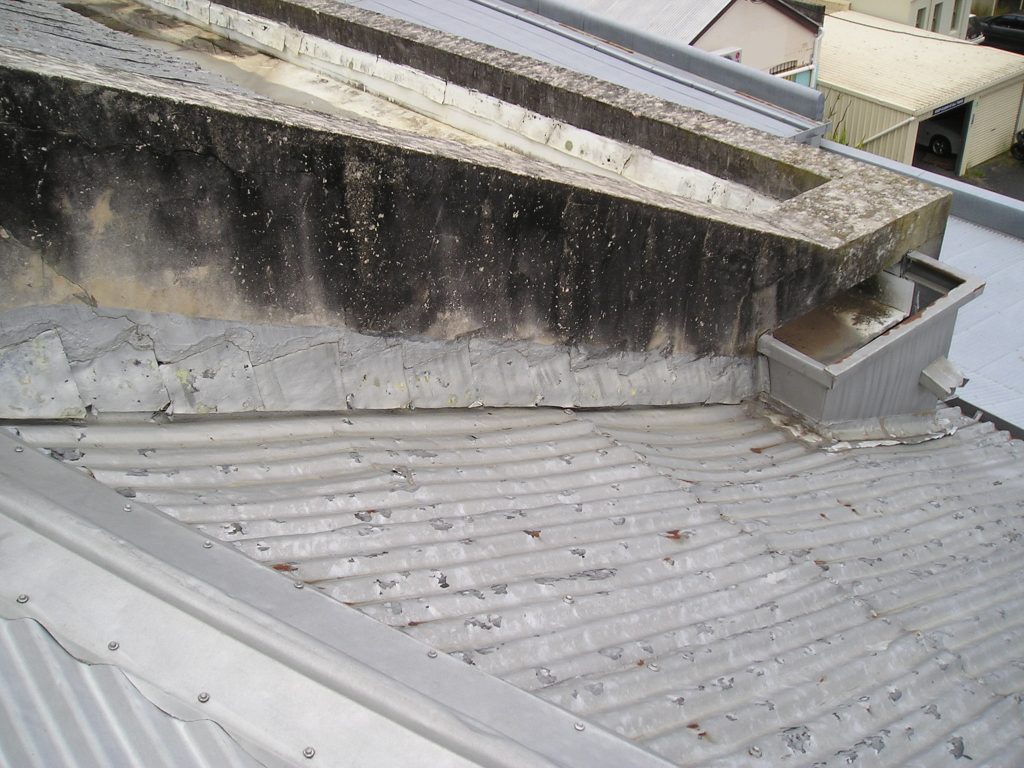
Storm warnings, radar imagery and recorded hail sizes can establish that severe weather occurred in an area. They do not, by themselves, establish what happened to a particular building. For insurers, loss adjusters and property owners, that distinction matters.
Australia does not have a shortage of hail claims.
The Insurance Council of Australia reports that the November 2025 Queensland and New South Wales severe storms and hail catastrophe had generated approximately 95,700 claims and $2.22 billion in incurred losses as at June 2026.
When claim volumes reach that scale, weather information becomes an important part of the assessment process. Radar records, severe thunderstorm warnings, reported hailstone sizes, eyewitness accounts and event timing can all help establish what conditions were present.
But there is an important distinction.
Evidence that hail occurred is not automatically evidence that hail caused the damage being claimed.
That second question usually has to be answered at the property.
What does Bureau of Meteorology data actually tell us?
The Bureau of Meteorology classifies a thunderstorm as severe when it is producing, or expected to produce, hazards including hail of at least 2 cm in diameter. Hail of 5 cm or more is classified as giant hail.
That information is extremely useful when reconstructing an event. So are radar images.
However, the Bureau also explains some of the limitations of interpreting weather radar. Radar detects precipitation at different levels of the atmosphere and hail can change considerably before reaching the ground. Hail may melt while falling through warmer air, while strong radar returns at altitude do not necessarily mean the same conditions occurred at ground level.
Storms can also be remarkably localised.
For a claims professional, the practical question is therefore not simply:
Was hail recorded somewhere in the area?
It is:
What weather conditions are reasonably supported at this property, at the relevant time, and are the observed damage patterns consistent with those conditions?
That requires more than a weather map.
The building has its own evidence
A forensic assessment should test the meteorological information against what is physically present.
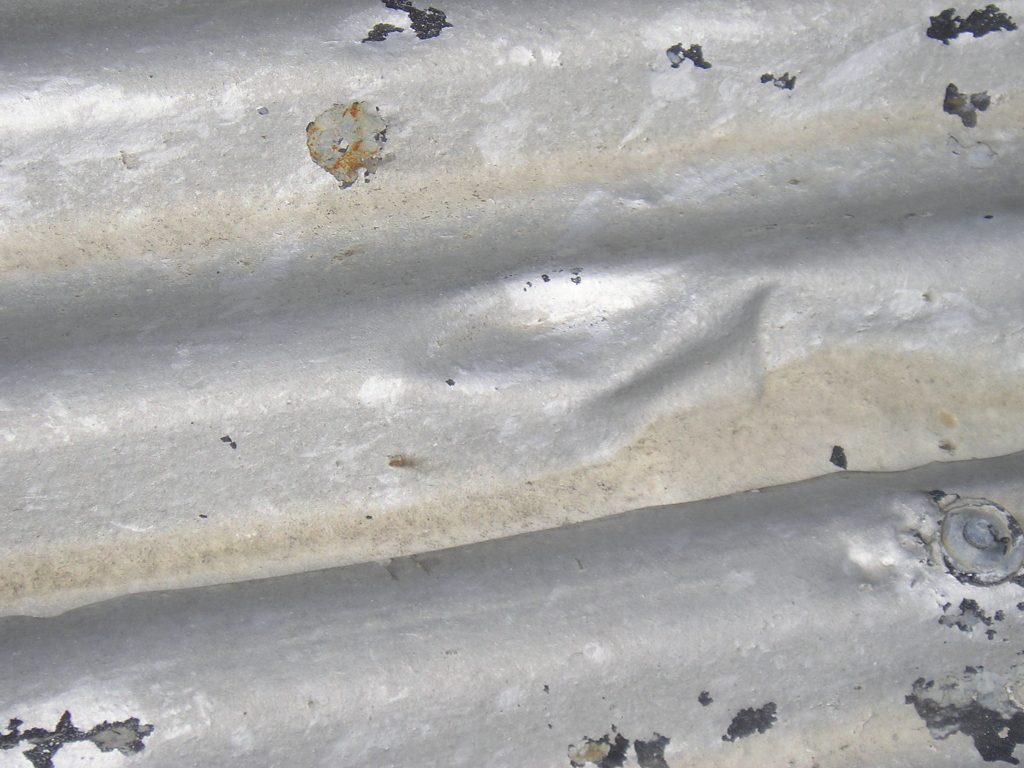
On a roof, that can mean examining the location and pattern of impact marks, roof profile and material, coatings, flashings, fixings, penetrations, gutters, skylights and other exposed components.
The surrounding property can also provide useful context. Fences, outdoor equipment, air conditioning units, solar components, vegetation and other exposed surfaces may help establish the direction and distribution of an event.
Just as importantly, the investigation should consider what was there before the storm.
Corrosion, previous repairs, installation defects, weathering, deteriorated sealants, maintenance issues and older mechanical damage do not disappear simply because a severe storm subsequently passes over the property.
This is where causation becomes more complicated than matching a postcode to a hail report.
Research following Brisbane’s severe November 2014 storm provides a useful example. James Cook University investigators found substantial differences in building performance depending on age, construction and material condition. Wind driven hail caused extensive window damage, particularly in older housing, while some significant roof failures were associated with older structural details and inadequate connections rather than wind speeds exceeding contemporary design levels.
The event was real. The resulting damage mechanisms were not identical from building to building.
Hail size alone does not determine the answer
There is an understandable temptation to reduce hail causation to a simple equation:
Large hail equals damaged roof.
In practice, material performance is more complicated.
Research undertaken at the University of Wollongong into hail impact on steel roofing highlights the influence of factors including sheet thickness and material yield strength on dent resistance.
That is why broad statements such as “hail of this size must have damaged this roof” should be treated cautiously unless supported by the particular construction and physical evidence.
Two neighbouring buildings may experience the same storm and show different damage.
One may have newer roofing. Another may have aged materials, previous damage, different orientation, different fixings or a different roof profile.
The forensic task is to establish what the available evidence supports for the building being assessed.
Impact is not necessarily the same as damage
This distinction is increasingly relevant in disputed hail claims.
In June 2026, AFCA published a dedicated External Dispute Resolution response guide for hail damage claim complaints, reflecting the volume and complexity of these disputes.
A published AFCA hail decision also illustrates an important technical distinction. Experts may agree that hail struck a roof yet disagree about whether those impacts caused damage to the insured property.
For claims teams, this is precisely why the reasoning inside an expert report matters.
The Insurance Council of Australia’s Expert Reports Industry Best Practice Standard says expert reports should identify the relevant evidence, explain the reasoning supporting the opinion, consider all relevant matters and, where there are multiple causes, address the extent to which each contributed to the loss.
Reports should also be factual, neutral and based on substantiated facts or clearly identified assumptions.
The current General Insurance Code of Practice also requires insurers to engage external experts with appropriate expertise and allows customers to request copies of external expert reports relied upon in assessing their claim.
That places considerable weight on how clearly causation has been established.
What should a defensible hail investigation consider?
A sound assessment brings several evidence streams together rather than allowing one source to dictate the conclusion.
That generally means establishing the timing and location of the weather event, reviewing available meteorological information, documenting the building’s existing condition, mapping the observed damage, considering the characteristics of the affected materials and testing plausible alternative causes.
Pre event photographs, maintenance records, previous reports and repair documentation can be particularly valuable when the age of a defect is disputed.
Where the issue involves general building fabric and causation, MBC’s disaster assessment and damage reporting services provide a pathway for documenting event related and pre existing conditions.
Where the investigation needs to progress from causation into a defined repair methodology, MBC’s building reports and scopes of works can establish what rectification is supported by the findings.
If there are questions about structural adequacy, roof framing, load paths or structural failure, the matter may require assessment by one of MBC’s registered independent engineers or a formal structural engineering report.
The appropriate technical discipline depends on the question that needs to be answered.
Can radar prove that hail damaged a roof?
Not by itself.
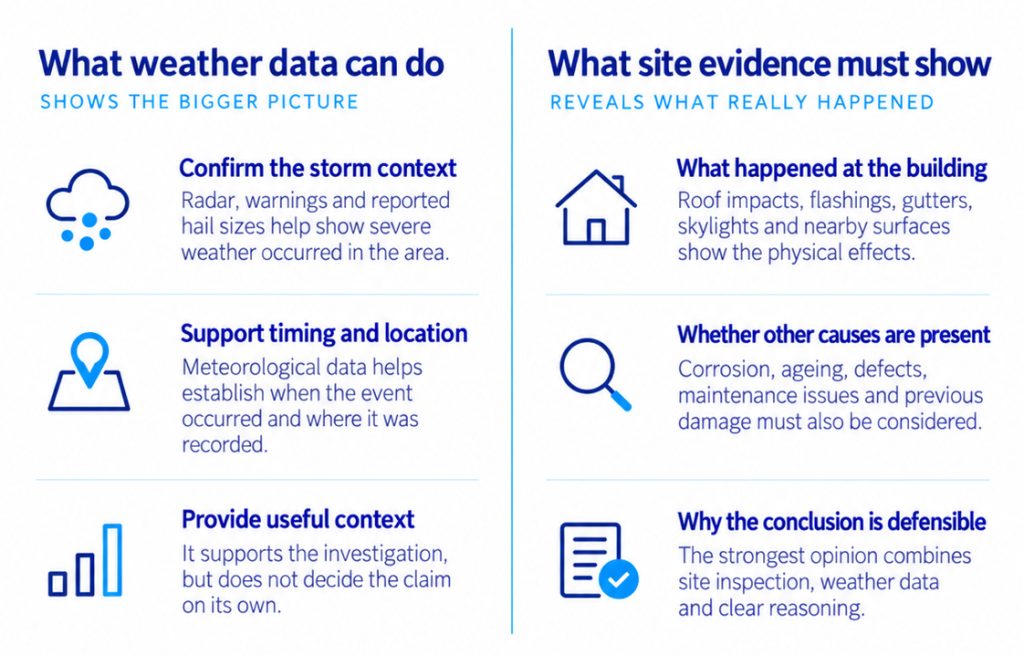
Radar, warnings and recorded hail observations can provide strong evidence about the weather event. They establish context.
Physical inspection establishes what happened to the building.
The strongest causation opinion is reached when those two evidence streams support one another. Where they do not, the discrepancy should be investigated rather than explained away.
That is particularly important in insurance matters because an independent consultant’s role is not to produce the answer that an insurer, property owner or repairer wants.
It is to establish what the evidence supports.
Weather data tells us about the storm. The building tells us what the storm actually did.