



As insurers move into the summer claims period, the pressure is usually to get expert reports back quickly. Speed matters. But an expert report can influence causation, repair scope, reserves and the eventual claim decision, so the more important question is whether the opinion is strong enough to rely on.
ASIC’s 2025 follow-up review of home insurance claims handling found that oversight of independent experts was less developed than oversight of builders and repairers. Quality assurance often focused on timeliness rather than report quality or accuracy, with claims-handling staff generally relied on to identify errors.
That makes critical review of expert opinion part of good claims handling.
What makes an expert report defensible?
A defensible report lets another reader understand what the expert was asked, what evidence was considered, what assumptions were made and why the conclusion follows.
The Insurance Council of Australia’s Expert Reports Industry Best Practice Standard expects reports to be factual, neutral and accessible, with supporting information, reasoning, evidence and conclusions clearly set out. It also expects claims managers to critically examine the report.
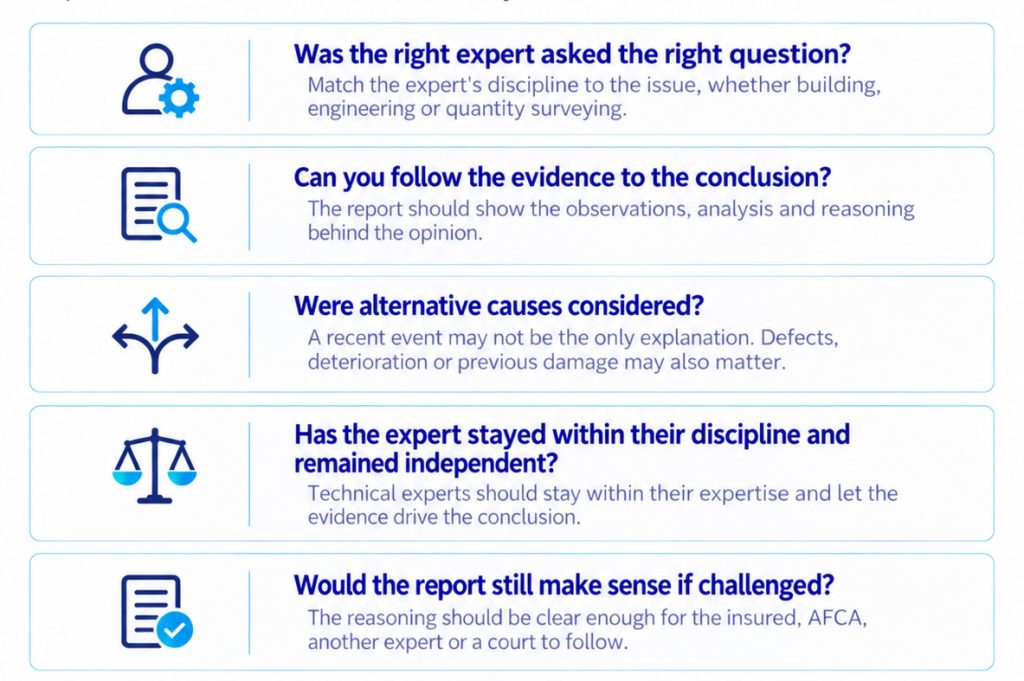
Before relying on a report, five questions are worth asking.
1. Was the right expert asked the right question?
A long list of qualifications does not make someone the right expert for every building issue.
A licensed building consultant may investigate general building condition, workmanship, water entry, event-related damage and practical rectification. Questions about structural adequacy, load paths, structural movement or engineering design may require a suitably qualified engineer.
The current General Insurance Code of Practice says an insurer should engage an external expert only where it believes that person has the appropriate expertise. Registration also matters. In Queensland, professional engineering services generally must be carried out by a Registered Professional Engineer of Queensland unless an exception applies.
MBC’s independent engineers can be engaged when a claim moves beyond general building causation into structural performance or engineering analysis.
The test is simple. Does the expert’s actual expertise match the question being answered?
2. Can you follow the evidence to the conclusion?
A conclusion should not require the reader to fill in missing steps.
If a report says movement was caused by leaking drainage, storm damage resulted from wind uplift, or cracking is consistent with long-term settlement, the evidence and reasoning supporting that opinion should be visible.
The Insurance Council’s standard calls for clear and cogent reasoning, substantiated facts or assumptions, and no inconsistencies between commentary and findings.
The National Construction Code takes a similar approach where reports are used as evidence of suitability. A report from a professional engineer or appropriately qualified person should set out the basis for the opinion and the standards or other material relied upon.
For claims teams, the practical check is: could another qualified reader follow the logic from the evidence recorded?
MBC’s building reports and scopes of works connect site observations, causation findings and the rectification pathway.
3. Were plausible alternative causes considered?
Property damage rarely arrives with a label identifying its cause.
A recent storm can coexist with corrosion. Water ingress can occur alongside defective flashing. New cracking may sit beside older movement.
The Insurance Council’s Best Practice Standard says reports should consider all relevant matters and, where there are multiple causes, address the extent to which each contributed to the loss.
The useful question is not simply, “What cause did the expert select?”
It is, “What other reasonable explanations were tested, and why were they accepted or excluded?”
Targeted site investigations can help where the initial evidence is not enough to distinguish between competing causes.
4. Has the expert stayed within their discipline and remained independent?
Technical experts provide technical opinions. They do not determine insurance coverage.

The Insurance Council’s guidance says experts should not provide views about the application of policy terms, and claims managers should disregard statements outside the expert’s scope or expertise.
The Federal Court’s Expert Evidence Practice Note says an expert witness is not an advocate and must provide impartial evidence within their area of expertise. Experts should also be prepared to change an opinion where the evidence requires it.
Most insurance building reports will never reach court. The principle still matters earlier in the claim. The opinion should follow the evidence, not the interests of the party who commissioned it.
Where a matter is contested, MBC’s construction dispute resolution services provide independent technical assessment to clarify the issues.
5. Would the report still make sense outside the original claim team?
Under the current General Insurance Code of Practice, customers can request copies of external expert reports relied upon in handling their claim. The report may later be read by the insured, a broker, another expert, AFCA, a solicitor or a court.
AFCA’s preliminary 2025 to 2026 data recorded 36,022 general insurance complaints, up 5 per cent, with delay in claim handling, service quality and claim rejection among the leading issues. In separate 2026 guidance, AFCA identified unclear or inconsistent information as a strong indicator that a complaint may escalate.
A report containing unexplained terminology, conflicting statements or unsupported assumptions creates avoidable risk.
What should a claims team do if the report does not pass these tests?
An expert report should be examined, not simply filed.
If reasoning is unclear, evidence appears to be missing, conclusions contradict observations, or the expert has provided only a tentative opinion on a decisive issue, those points should be raised before the report becomes the foundation of a claim decision.
The Insurance Council’s standard recommends raising concerns with the expert and considering whether a further report may be beneficial where an opinion remains tentative.
An expert report is not the claim decision. It is evidence used to inform that decision.
The strongest reports identify the facts, show the reasoning, acknowledge uncertainty where it exists and remain within the author’s expertise.
If the report is later challenged, that reasoning should already be there.