


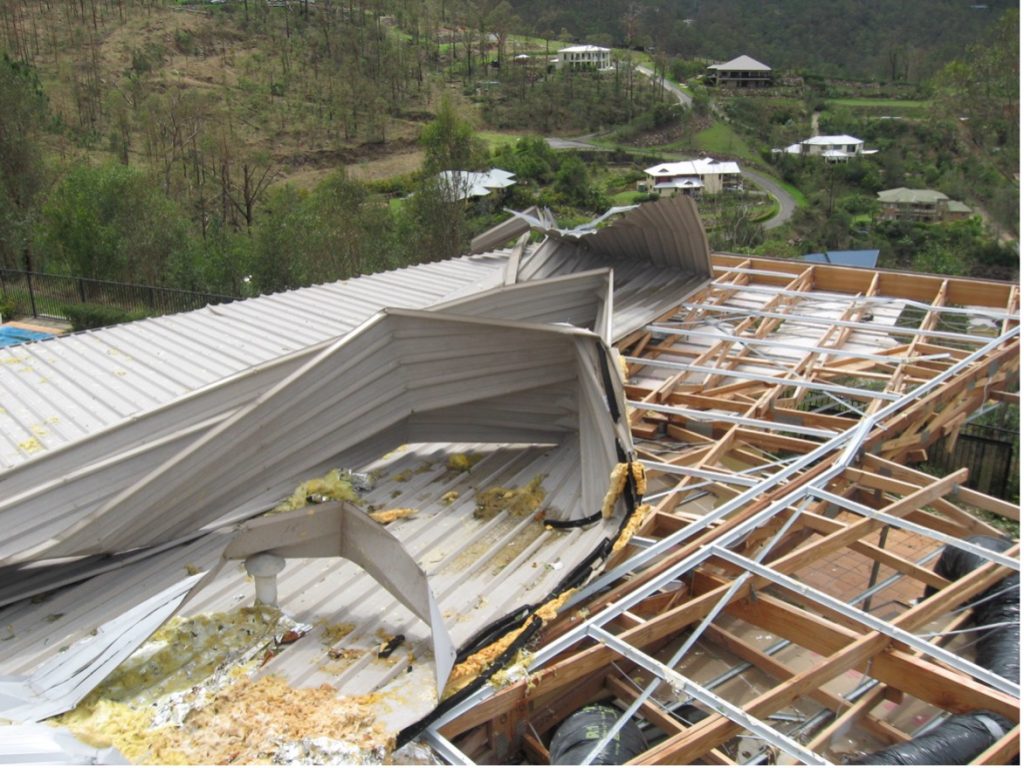
Temporary tarps, debris removal, emergency demolition, drying and other make-safe works are often essential after a major storm. They can also change the very conditions an expert may later need to interpret.
The issue is not whether safety or evidence comes first. Safety does.
The challenge is preserving what matters before the site changes, wherever that can be done safely.
After severe weather, damaged roofing may need to be tarped, fallen material removed, water extracted and electrical systems isolated. The Insurance Council of Australia describes make-safe work as immediate action undertaken to remove hazards and prevent further property damage.
That response can be necessary.
It can also alter the physical evidence.
Can make-safe work affect a storm damage assessment?
Yes.
A causation assessment rarely depends on one damaged item in isolation.
The position, orientation and condition of materials can matter. So can water staining, displaced components, failed fixings, debris patterns, impact marks and the relationship between one damaged element and another.
If roof sheeting is removed, the relationship between the sheet, fixings and framing may be lost. If a ceiling cavity is dried, the moisture pattern changes. If debris is cleared without recording where it was found, information about the direction or mechanism of failure may disappear.
That becomes important when the later question is not simply whether a building was damaged, but:
What caused the damage, when did it occur and which parts of the observed condition belong to the claimed event?
The Insurance Council’s Expert Reports Industry Best Practice Standard says expert opinions should be based on substantiated facts and clear reasoning. Where several causes may exist, the report should address the extent to which each contributed to the loss.
That task becomes harder when the site’s original condition is no longer available.
What evidence should be captured before make-safe work begins?
Where it is safe and practical, the simplest principle is to record the site before changing it.
The Insurance Council, ASIC, AFCA and Legal Aid Queensland all provide guidance around photographing or recording damage before clean-up or repairs proceed.
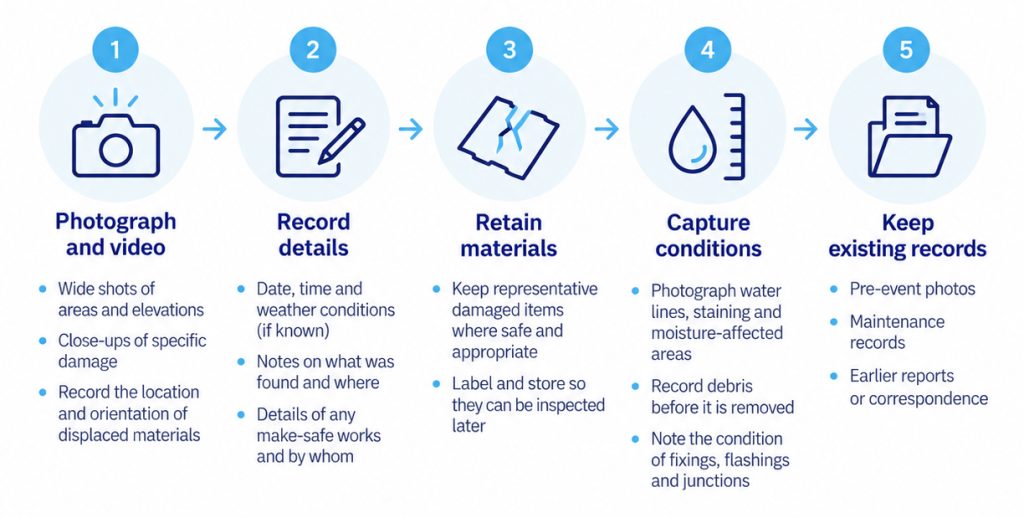
For a complex property claim, the useful record may include:
- wide photographs showing the overall room, elevation or roof area
- close photographs of specific damage, fixings, flashings and junctions
- the location and orientation of displaced materials
- water lines, staining and moisture-affected areas
- debris before it is moved
- dates, times and details of make-safe works
- removed materials retained for later inspection, where safe and appropriate
- pre-event photographs, maintenance records and earlier reports
This does not mean emergency contractors need to become forensic investigators.
It means leaving enough of a record for the building consultant or engineer who may later need to determine causation.
A sound storm damage building assessment depends on context. A photograph taken before a roof is tarped or a failed component is removed may later explain something that cannot be reconstructed from the repaired site.
Should make-safe work be delayed until an expert attends?
Generally, no.
Immediate safety and reasonable steps to prevent further loss come first.
The Insurance Council’s disaster guidance advises people to take reasonable steps to prevent further damage while working with their insurer on the claims process.
There are situations where waiting would be inappropriate.
An unstable structure may need urgent intervention. Damaged electrical systems may require isolation. Saturated materials can create health risks. Exposed roofing may allow further rainwater entry.
Some damaged buildings may also contain asbestos or other hazards. SafeWork NSW warns that storm and flood-damaged properties can involve structural instability, electricity, chemicals and asbestos.
Evidence should never be preserved by placing people at risk or unnecessarily disturbing hazardous materials.
The practical approach is straightforward:
Make the site safe first. Where circumstances allow, record the condition before it changes.
Why do before-and-after records matter?
Make-safe work can itself form part of the evidence trail.
If temporary roofing is installed, record what was beneath it beforehand.
If damaged material is removed, record what was removed and where it came from.
If water is extracted, photograph staining and water levels first where safe.
If part of a structure requires emergency demolition, record its condition beforehand if the safety situation permits.
Legal Aid Queensland also recommends retaining records of repairs and documenting the property before and after work where circumstances allow.
That continuity can become particularly important where several explanations for the damage are possible.
A severe storm can occur at the same property as corrosion, defective workmanship, deterioration or earlier damage. The presence of the storm does not remove the need to test those competing explanations.
Forensic building consultancy in a disputed claim therefore relies not only on evidence that an event occurred, but on evidence showing what that event actually did to the building.
What happens if the evidence has already been removed?
Not every claim will have a complete pre-intervention record.
During a major catastrophe event, occupants may clean up before an assessor attends. Emergency contractors may remove materials. Roofs may already be covered. Debris may have been collected.
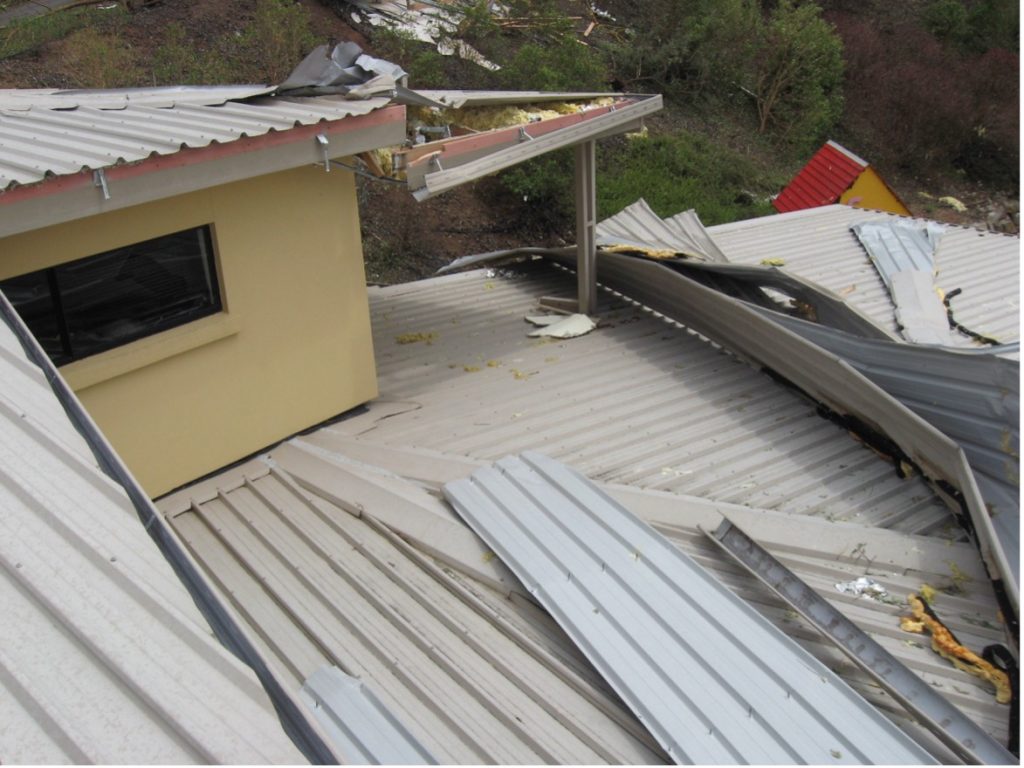
The investigation then has to work with what remains.
That can include photographs taken by occupants, repairers or emergency services, CCTV footage, weather data, invoices, contractor notes, retained materials, maintenance records, earlier photographs and the remaining physical condition of the property.
AFCA’s storm and flood guidance recommends gathering as much supporting information as possible where a dispute arises.
A defensible report should also acknowledge the limits of that evidence.
If earlier intervention means a conclusion cannot be reached with the same level of certainty, that limitation should be stated rather than concealed.
Where a claim requires an independent assessment of event-related and pre-existing damage, MBC’s disaster assessment and damage reporting services can establish the initial causation picture.
Where the available evidence requires closer examination, site investigation services can test competing explanations.
Those findings can then inform building reports and scopes of works, while questions involving structural stability, framing failure or structural adequacy may require appropriately qualified independent engineers.
Protecting evidence without delaying safety
Make-safe work and causation assessment are not competing processes.
One protects people and property from immediate risk. The other establishes what happened and what the evidence supports.
The problem arises when the first process unintentionally removes information required for the second.
Good evidence preservation does not require a complicated forensic protocol at every property.
Sometimes it is a sequence of photographs. A measurement. A retained component. A contractor note recording what was found before work began.
Weeks or months later, that record can become critical if causation is disputed.
Make it safe. But where safety allows, record it before you change it.