



Catastrophe response is often judged once claims start arriving. In practice, many of the decisions that determine how well a surge is handled need to be made before the first file lands.
Australia’s recent claims experience shows how quickly volumes can build.
The Insurance Council of Australia reported that declared extreme weather events generated 294,000 claims and $4.8 billion in insured losses during 2025. Ex-Tropical Cyclone Alfred alone had generated approximately 131,000 claims and $1.61 billion in incurred losses by June 2026.
Numbers of that scale put pressure on inspections, consultant allocation, engineering capacity, report quality and repair scoping at the same time.
That is why CAT readiness should begin before the first weather warning is issued.
Storm season is also a capacity test
Australia’s tropical cyclone season runs from 1 November to 30 April, with the Bureau of Meteorology issuing its seasonal outlook in the second week of October.
The Bureau of Meteorology no longer issues a seasonal tropical cyclone outlook, after finding that the historical model used to estimate cyclone numbers had become less reliable as the climate changes. Instead, it provides seasonal information and a seven-day tropical cyclone forecast, updated at least twice daily, showing significant tropical lows, their likely movement and the risk of cyclone development.
This reinforces the importance of preparing in advance. Regional inspection capacity, engineering escalation procedures and evidence requirements should be established before a cyclone threatens the coast, not once claims begin arriving.
For claims teams, the practical question is not whether a catastrophe will occur. It is whether the people, suppliers and processes are ready if claim volumes rise rapidly.
Decide what a useful first instruction looks like
One of the simplest ways to lose time during a CAT event is to send an assessor an incomplete file.
A street address and a note saying “storm damage to roof” may create a job, but it rarely provides enough information to plan the right inspection.
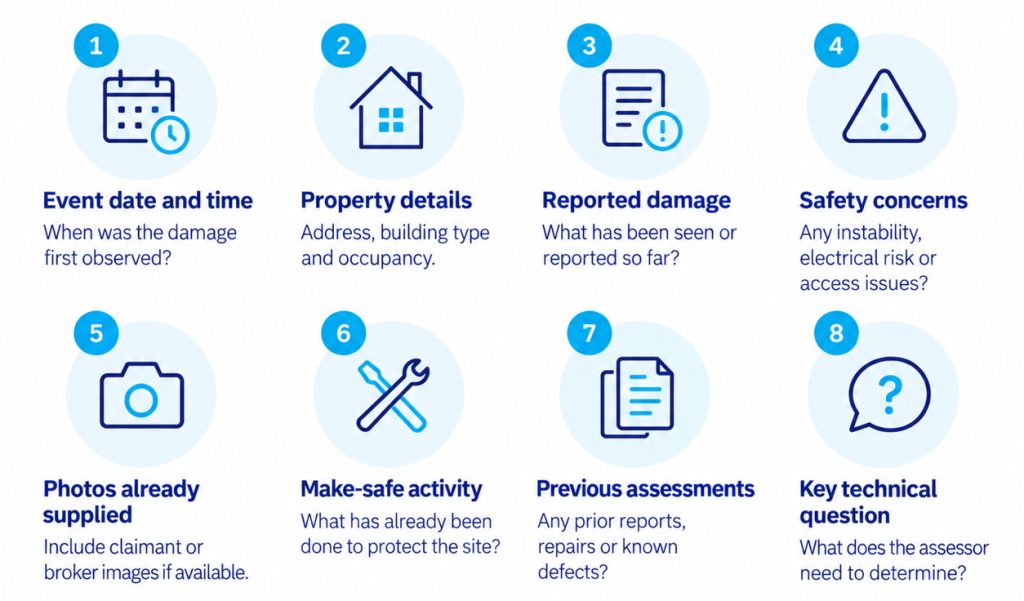
An effective instruction should identify the event date, reported damage, known safety concerns, property type, available photographs, make-safe activity, previous assessments and the technical question requiring investigation.
It also helps to distinguish facts from conclusions.
“Water entered the bedroom during the storm” is an observation.
“The storm damaged the roof” is a causation conclusion that may still need to be tested.
Good triage should direct the investigation, not determine its outcome before anyone reaches the site.
Triage is not the same as causation
During a major event, claims have to be prioritised according to safety, urgency and complexity.
But triage should remain triage.
A photograph of a cracked wall, displaced roof sheet or water-stained ceiling may justify an urgent inspection. It does not necessarily establish why the condition occurred or whether all of the damage resulted from the recent event.
An independent disaster assessment and damage report can examine the physical evidence and distinguish event-related damage from pre-existing defects, deterioration and other contributing factors.
The first assessment should also identify when the file needs more specialised expertise.
When should a storm claim be escalated to an engineer?
Not every catastrophe claim requires engineering input.
During a surge, that distinction matters. Registered engineering capacity should be directed towards matters where the technical question actually requires it.
A licensed building consultant may investigate general building condition, visible damage, water entry, workmanship and causation. Questions involving structural adequacy, stability, load paths, significant structural movement or engineering design may require a suitably qualified and, where applicable, registered professional engineer.
The Insurance Council of Australia’s Expert Reports Industry Best Practice Standard reinforces the importance of using experts with appropriate expertise and keeping opinions within their relevant discipline.
Possible escalation triggers include partial collapse, suspected framing failure, significant movement, substantial structural cracking or uncertainty about whether a building can safely remain occupied.
MBC’s independent engineers can be engaged when a claim moves beyond general building causation into structural performance or adequacy.
Those escalation pathways are much easier to manage when they are established before a CAT event.
Protect the evidence before the site changes
Catastrophe sites rarely remain untouched for long.
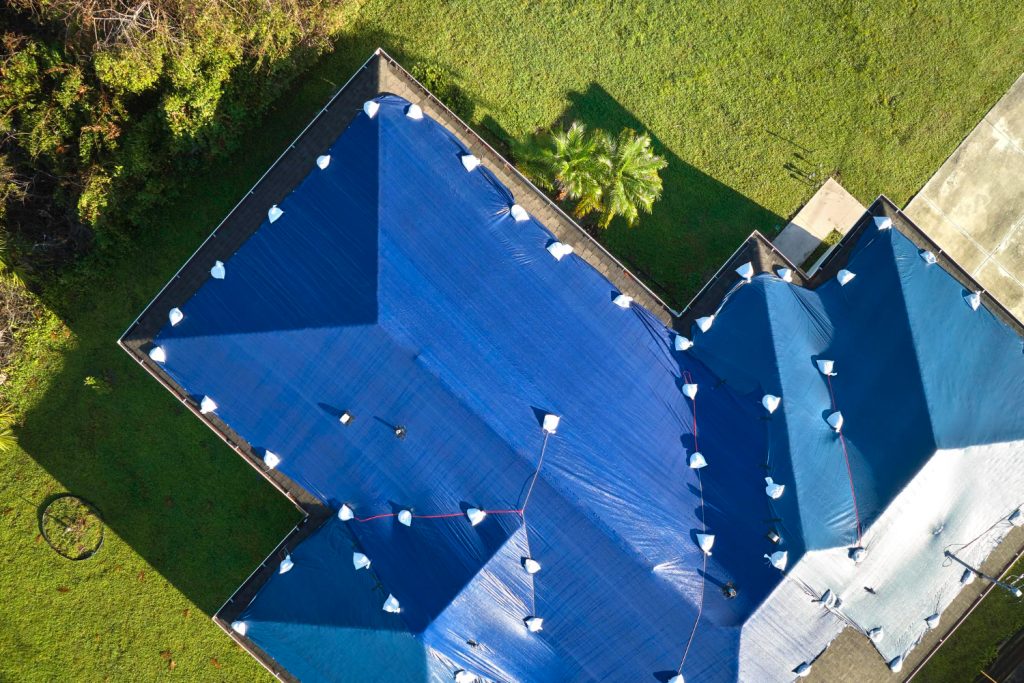
Roofs are tarped. Trees are removed. Water is extracted. Damaged materials may be stripped out. Emergency make-safe work begins because people and property need to be protected.
Those actions may be necessary, but they can also alter the conditions an expert later needs to interpret.
The answer is not to delay urgent work. Safety and loss mitigation come first.
Instead, evidence capture should form part of the process.
Where safe and practical, photographs, locations, observations and the condition of affected components should be documented before materials are covered, moved or removed.
Pre-event photographs, maintenance records, previous reports and earlier repair documentation can also become important if the age or cause of damage is later disputed.
A good evidence trail gives the subsequent causation investigation a much stronger starting point.
Report quality cannot fall because volume rises
Speed matters during catastrophe response.
But a fast report that leaves the claims handler asking what caused the damage, what evidence supports the conclusion or what belongs in the repair scope may simply move the delay further down the claim.
AFCA recorded 36,022 general insurance complaints in 2025 to 2026, up 5 per cent, with claim-handling delays among the major complaint issues.
At the same time, the General Insurance Code of Practice provides for customers to receive certain reports relied upon during the assessment of their claim.
A technical report therefore needs to be capable of explaining its reasoning beyond the immediate claims team.
The insured, another expert, AFCA, a solicitor or a court may ultimately examine it.
Observation, interpretation and conclusion should remain clear, even when report volumes increase.
Where findings need to progress into defined rectification requirements, MBC’s building reports and scopes of works can provide that next stage of the technical process.
Capacity means more than having a supplier on a panel
Technical capability and surge capability are different things.
Claims teams should know where consultants are located, which disciplines are available, how engineering referrals are handled, how reports are reviewed and what contingency arrangements exist if travel or access becomes difficult.
This also sits within the insurance industry’s wider focus on operational resilience. APRA’s CPS 230 Operational Risk Management places greater emphasis on maintaining critical operations and managing risks associated with service providers.

The broader lesson is straightforward: external capacity is better understood before disruption occurs than during it.
What should a CAT claims readiness plan include?
Before storm season, claims teams should have clarity around:
- minimum information required when a file is instructed
- safety, urgency and complexity triage criteria
- triggers for engineering or specialist escalation
- site evidence and reporting requirements
- regional consultant capacity and contingency arrangements
- report quality assurance during volume surges
- responsibilities between insurer, adjuster, consultant and repairer
The aim is not to predict the next catastrophe.
It is to remove avoidable uncertainty when one occurs.
Once thousands of claims are entering the system, there is little spare time to decide what information an assessor needs, when an engineer should become involved or what constitutes a complete technical report.
The strongest CAT response usually begins before there is a CAT to respond to.