


Strata committees rarely get warned with a single dramatic failure. More often, the warning signs are small. A recurring leak in the foyer. Rust staining at a balcony edge. Mould that returns after every wet spell. A crack that gets patched, then quietly reappears.
The problem is that these issues are easy to treat as maintenance items when they may actually point to a deeper common property defect.
That matters in New South Wales because the legal duty is not vague. Under Strata Schemes Management Act , an owners corporation must properly maintain and keep common property in a good and serviceable state of repair. At the same time, Building Commission NSW research found that 53 per cent of surveyed strata buildings had experienced serious defects in common property, with waterproofing and fire safety among the most commonly reported categories.
That combination creates a practical challenge for committees. If they wait too long, small defects can become major repair programs. If they move too quickly on incomplete information, they can spend money on patch repairs that do not solve the real problem.
Why common property issues become expensive so quickly
In strata, delay has a habit of compounding.
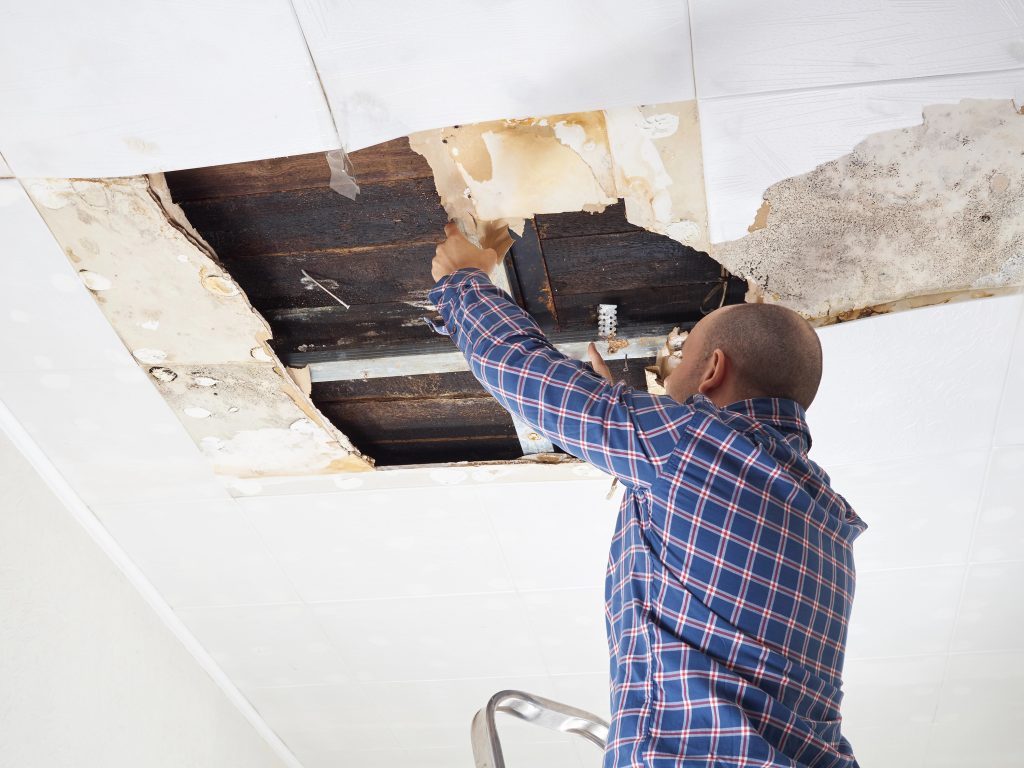
A minor ceiling stain might seem like a local defect. In reality, water can travel through cavities, across slabs, behind cladding and along structural elements before it appears inside a lot or on common property. By the time the symptom is visible, the failure path may already be well established.
That is one reason waterproofing defects cause so much disruption in apartment buildings. The Australian Building Codes Board’s NCC 2025 preview highlights improved water management provisions in Volume One, which is especially relevant for apartments and mixed-use buildings. It is a reminder that water ingress is not just a maintenance nuisance. It is one of the biggest drivers of recurring damage, remedial cost and disputes about what should have been done earlier.
The real question is not “what needs patching?”
When a defect appears, committees often jump straight to the repair method. Repaint the wall. Patch the slab. Reseal the joint. Replace the flashing.
But the more useful question is earlier than that. What is actually causing the problem?
If concrete is spalling from a balcony edge, the answer may be failed waterproofing, poor drainage, inadequate concrete cover, corrosion from long-term moisture entry, or a later penetration through the membrane. If mould is recurring in several lots, poor ventilation may be part of the picture, but so might facade leakage or trapped moisture inside the wall build-up.
That distinction matters because patching a symptom is rarely the same as fixing the defect. It also matters because evidence of cause can affect later recovery options, remedial planning and how an owners corporation prioritises future spending.
Why committees need evidence before they need a contractor
This is where many strata schemes lose time and money.
A contractor is usually brought in to price work. That is useful, but pricing is not diagnosis. If the cause is wrong, the scope is wrong. And if the scope is wrong, the building can end up going through the familiar cycle of patch, fail and pay again.
A better starting point is an independent building report with defect evidence that explains the below:
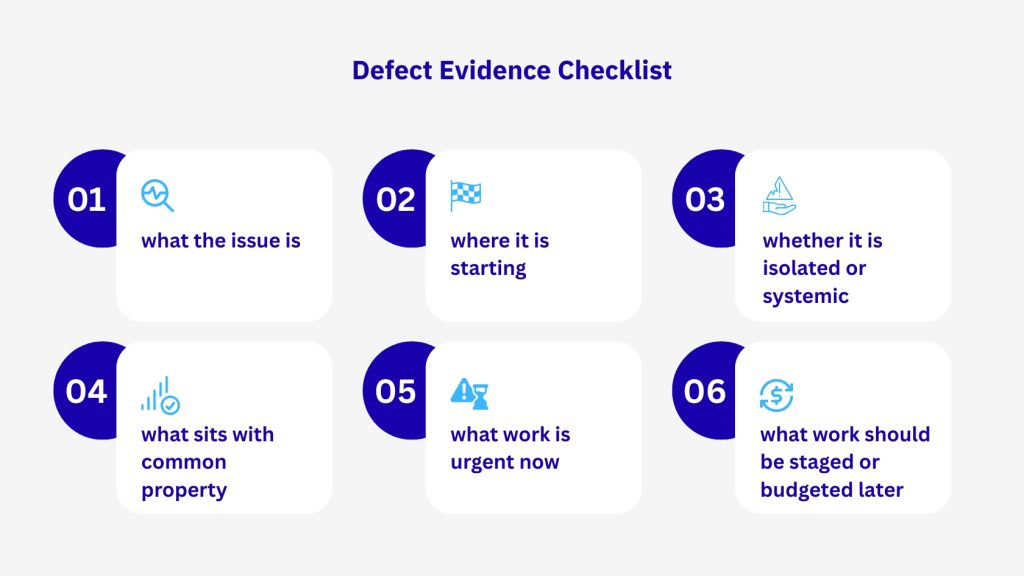
That approach gives committees something more valuable than a fast quote. It gives them a basis for decisions.
The legal backdrop has become harder to ignore
There is another reason early evidence matters.
Under section 37 of the Design and Building Practitioners Act 2020, a person who carries out construction work owes a duty to exercise reasonable care to avoid economic loss caused by defects. That does not mean every defect becomes a claim against a builder or consultant. It does mean that where rights may exist, they are much easier to assess when the cause, extent and chronology of the defect have been properly documented.
Without that clarity, committees can end up in the worst middle ground. They know the building has a problem, but they do not yet know the right repair path, the likely cost, or whether someone else may ultimately be responsible.
Why this is also a budgeting issue, not just a building issue
Strata defect decisions are never purely technical. They are financial.
That is why the capital works angle is so important. Under the same Act, owners corporations should prepare a 10-year capital works fund plan.

NSW has also introduced a standard form for new and revised plans, with guidance making clear that the purpose is to identify and budget for major repair, maintenance or replacement costs affecting common property.
For committees, that changes the conversation. A defect investigation is not just about working out what is wrong today. It is about understanding whether the issue requires immediate rectification, staged remedial works, closer monitoring, or a more serious reforecast of future capital expenditure.
In other words, better defect evidence supports better levy planning.
A more useful mindset for strata committees
The old reactive model is simple. Wait for the complaint. Call someone out. Fix what is visible. Hope it holds.
The problem is that this approach usually treats buildings like a series of isolated incidents. Strata assets do not behave that way. Common property systems are connected. Balconies, facades, roofs, membranes, drainage paths and structural elements all affect each other.
A better mindset is to treat recurring defects as signals. Not every stain is a crisis. But repeated symptoms are usually worth investigating before they become larger claims on the capital works fund or larger disputes among owners.
What should Strata Committees monitor?
For strata committees, the practical risk is not just deterioration. It is delay without evidence.
In NSW, serious common property defects remain common, the duty to maintain and repair common property is clear, and capital works planning is becoming more structured. Against that backdrop, early defect evidence helps committees make calmer decisions. It can clarify the cause of the issue, reduce the risk of repeat repairs, and give owners a more realistic basis for planning future works.
That is the sharper question for strata committees now. Not simply how to respond once the building forces the issue, but how early evidence can prevent common property problems from becoming expensive, recurring liabilities.
For more information on how Morse Building Consultancy can help identifying and monitoring your property contact the team today.