



Underinsurance is a quiet balance sheet killer. In Australia, roughly 83% of commercial properties are insured for less than their actual rebuild cost. When a major cyclone, flood, or fire occurs, the financial fallout is immediate. Getting an accurate valuation before a disaster strikes is the only way to avoid these post-catastrophe disputes.
Too many brokers and property owners confuse a Value at Risk (VAR) assessment with an Indemnity Valuation Report (IVR). These are entirely different mechanisms designed for different insurance policy structures. Misunderstanding the difference leaves companies exposed. This is where a qualified quantity surveyor becomes critical.
The Queensland Strata Legal Reality
In Queensland, regular valuations are not optional. Under Section 200 of the Body Corporate and Community Management (Standard Module) Regulation 2020, committees have a strict statutory duty to insure buildings for full replacement value. This rule applies to schemes registered under building format plans, like apartment blocks, and standard format plans with shared common walls, like townhouses.
The law mandates that body corporates obtain an independent valuation at least every five years. To understand these guidelines, committees can refer directly to the Queensland Government building insurance and valuation guide.
What do most committees do instead? They accept the insurer’s default 5% annual indexation. That is a mistake. Over a five-year cycle, this arbitrary compounding indexation can inflate your premium to absurd levels. Worse, it often fails to keep pace with volatile post-pandemic material surges, leaving you heavily underinsured.
Reviewing your actual replacement cost with a professional keeps you compliant and stops you overpaying. For more details on these legal requirements, you can check the official Queensland Government insurance obligations fact sheet.
What a Quantity Surveyor Actually Does on Site
You cannot run a real insurance program from a desk. A desktop assessment using historical cost-per-square-metre metrics is just educated guesswork. A professional quantity surveyor handles the math differently.
They perform a physical, forensic building inspection to measure the physical property. They inspect the load-bearing columns, identify the specific cladding systems, and document the site constraints. This hands-on process replaces speculative spreadsheets with defensible construction data.
Decoding the Value at Risk (VAR) Assessment
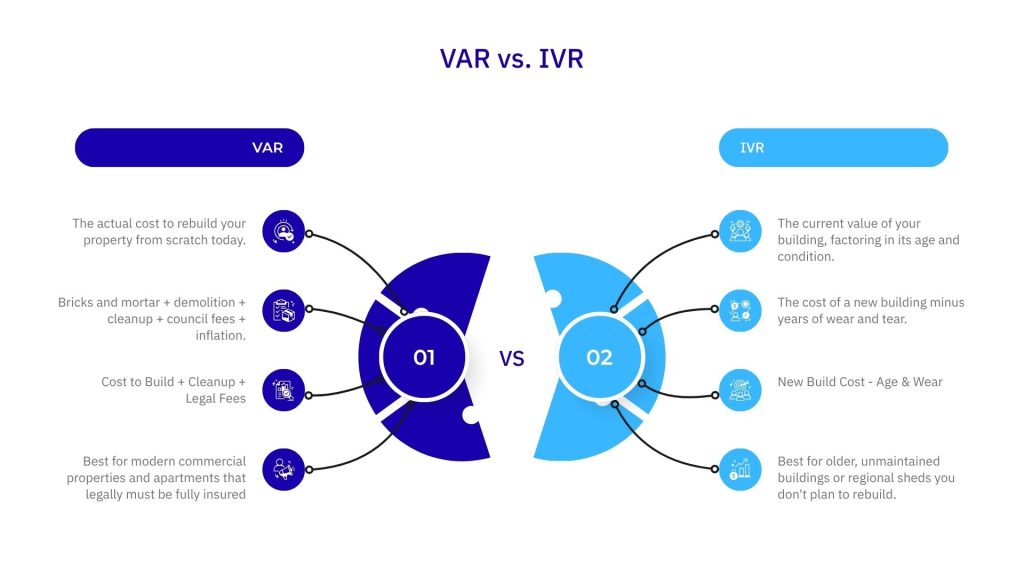
A VAR report calculates the hard cost of rebuilding from scratch.
The quantity surveyor measures the building footprint and calculates the current market rates for materials and labour. But they do not stop at the roofline. A proper VAR must factor in demolition, asbestos removal, council planning fees, engineering consultancy, and cost escalation during the rebuild period. If a rebuild takes 18 months, inflation will eat your budget unless it is calculated upfront.
You need a VAR to dodge the co-insurance average clause. If you declare a sum insured that is less than 80% or 90% of the actual replacement value, the insurer will slash your payout proportionally, even on minor, partial claims.
The Co-insurance Trap
Let’s look at how this plays out in a real claim. Suppose your warehouse has a true rebuild cost of $2,000,000. Your policy requires a 90% co-insurance limit ($1,800,000). To save on premium, you declare a sum insured of only $1,000,000. A small fire causes $200,000 of localised damage.
| Metric | Compliant Scenario | Underinsured Scenario |
| True Rebuild Cost | $2,000,000 | $2,000,000 |
| Co-insurance Rule (90%) | $1,800,000 | $1,800,000 |
| Declared Sum Insured | $1,800,000 | $1,000,000 |
| Partial Loss Claim | $200,000 | $200,000 |
| Actual Payout | $200,000 | $100,000 |
| Shortfall Borne | $0 | $100,000 |
Because you underinsured by half, you are penalised by half. The insurer pays $100,000, and you must find the other $100,000 from your own cash reserves to complete the repairs.
Why a Standard Replacement Valuation Fails
Standard replacement estimates are often completely useless when a catastrophe occurs.
They assume you are rebuilding the exact same structure. But you cannot do that. Modern regulations under the National Construction Code (NCC) 2025 (mandatory from May 2026) force you to upgrade the building. You must adhere to strict NCC compliance standards, which include expensive condensation management systems, mandatory commercial solar PV arrays, and specialized EV fire suppression in carparks.
Above-ground estimates also ignore structural realities. When a fire exceeds 300 degrees Celsius, concrete undergoes calcination. It loses structural integrity, spalls, and fails. While you might think replacing a steel shed costs $5 million, a full forensic review often reveals that the concrete slab is compromised. Demolishing, clearing, and re-pouring that slab can blow the true cost out to $16 million.
The Indemnity Valuation Report (IVR) Explained
What if you have an older, depreciated asset that you do not intend to rebuild to new standards? That is where the Indemnity Valuation Report comes in.
An IVR determines the property’s condition-adjusted actual cash value.
The math is straightforward:
This depreciation is not a tax-book write-down. It is a physical calculation based on age, wear, tear, and structural obsolescence.
Insurers use IVRs to prevent “betterment”. Betterment is a legal concept: you cannot profit from an insurance claim by getting a brand-new building to replace a run-down, century-old asset. An IVR establishes a defensible actual cash value baseline so both parties can agree on a fair payout without betterment disputes.
It is also useful in a hard insurance market. If a business owns a highly depreciated building, like an old regional packing shed, and wants to lower its premium, it can choose to insure on an indemnity basis, accepting that they will take a cash settlement instead of a physical rebuild.
If your goal is operational continuity, an IVR is useless. If a total loss occurs, a depreciated payout will leave you with a massive cash shortfall. You will not have enough funds to clear the site and construct a modern, compliant building, often leading directly to corporate insolvency.
VAR vs IVR: Side-by-Side
| Valuation Attribute | Value at Risk (VAR) | Indemnity Valuation Report (IVR) |
| Primary Goal | Establish full rebuilding costs. | Establish depreciated actual cash value. |
| Calculation Method | Rebuild Cost + Demolition + Fees. | Replacement Cost – Depreciation. |
| Best Suited For | Modern commercial and strata assets. | Older, neglected, or unmaintained assets. |
| Policy Type | Reinstatement (New for Old) policies. | Indemnity-based insurance policies. |
| Key Risk Managed | Underinsurance and co-insurance penalties. | Claim overpayment and premium costs. |
Work with Morse Building Consultancy
Relying on indexation or bank valuations is a gamble your committee or property owner does not need to take. Morse Building Consultancy brings over 38 years of construction and insurance-sector experience to every inspection. We deliver independent, insurer-grade assessments that stand up to the strictest scrutiny.
Contact us today to secure your property’s financial integrity.